Introduction
At a wedding, the atmosphere of the day is one of the things people remember most clearly, and music plays a fundamental role in that. Just as in films, a romantic scene without the right music does not have the same emotional impact.
That is why it's important to make an informed choice about the band for a wedding, especially when expectations are high and you want to create a truly special day.
In this guide, we will help you define all the details to consider and the criteria to use when making your choice, from the first idea to confirming the musicians, so you can create an unforgettable wedding celebration for you and your guests.
Step 1: Define the Atmosphere Before Choosing Songs
Before choosing a band, a song list or the number of musicians, define the atmosphere you want first.
Some weddings are intimate and romantic. Others are formal, scenic, almost cinematic: ask yourselves what you want the music to communicate. Should the ceremony feel delicate and intimate? Should the aperitivo have an Italian, relaxed and convivial character? Should dinner remain elegant and discreet? Should the reception become more energetic without turning into generic entertainment?
Jazz is especially effective because of this flexibility. An experienced ensemble can move from intimate background music to a warm, rhythmic performance without losing elegance. A duo can be perfect for the ceremony. A trio can create movement during the aperitivo. A quartet can bring more energy to the final part of the evening. The function changes, but the same refined aesthetic remains.
The most common mistake is starting from isolated individual songs. An entrance, a first dance or a dedication are important moments, but they should live within a broader musical identity. It is better to choose the overall atmosphere first, then the details of the repertoire.
The information you send to a band should make clear: the venue, the number of guests, the guest profile, the structure of the day and the atmosphere you want. A message such as "We're looking for a band for our wedding" is not specific enough. "We are getting married in June at a villa in Tuscany, with 90 guests, mostly Italian and English. Symbolic ceremony in the garden at 5 pm, aperitivo at sunset, dinner in the limonaia and first dance after the cake cutting. We want an elegant, relaxed atmosphere with a more rhythmic finale" is already much clearer.
Step 2: Map the Musical Moments of the Day
A wedding is a sequence of different moments, each with a specific function. The music should shape the rhythm of each one.
The ceremony requires focus. Whether it is religious, civil, symbolic or outdoors, the music should support the emotion without drawing attention away from the couple. A solo saxophone, voice and piano, guitar and saxophone, or a small acoustic ensemble can all work beautifully here.
Guest arrival is often underestimated. Guests may wait 20, 30 or 40 minutes before the ceremony or aperitivo begins. Light live music prevents the space from feeling empty and immediately communicates care.
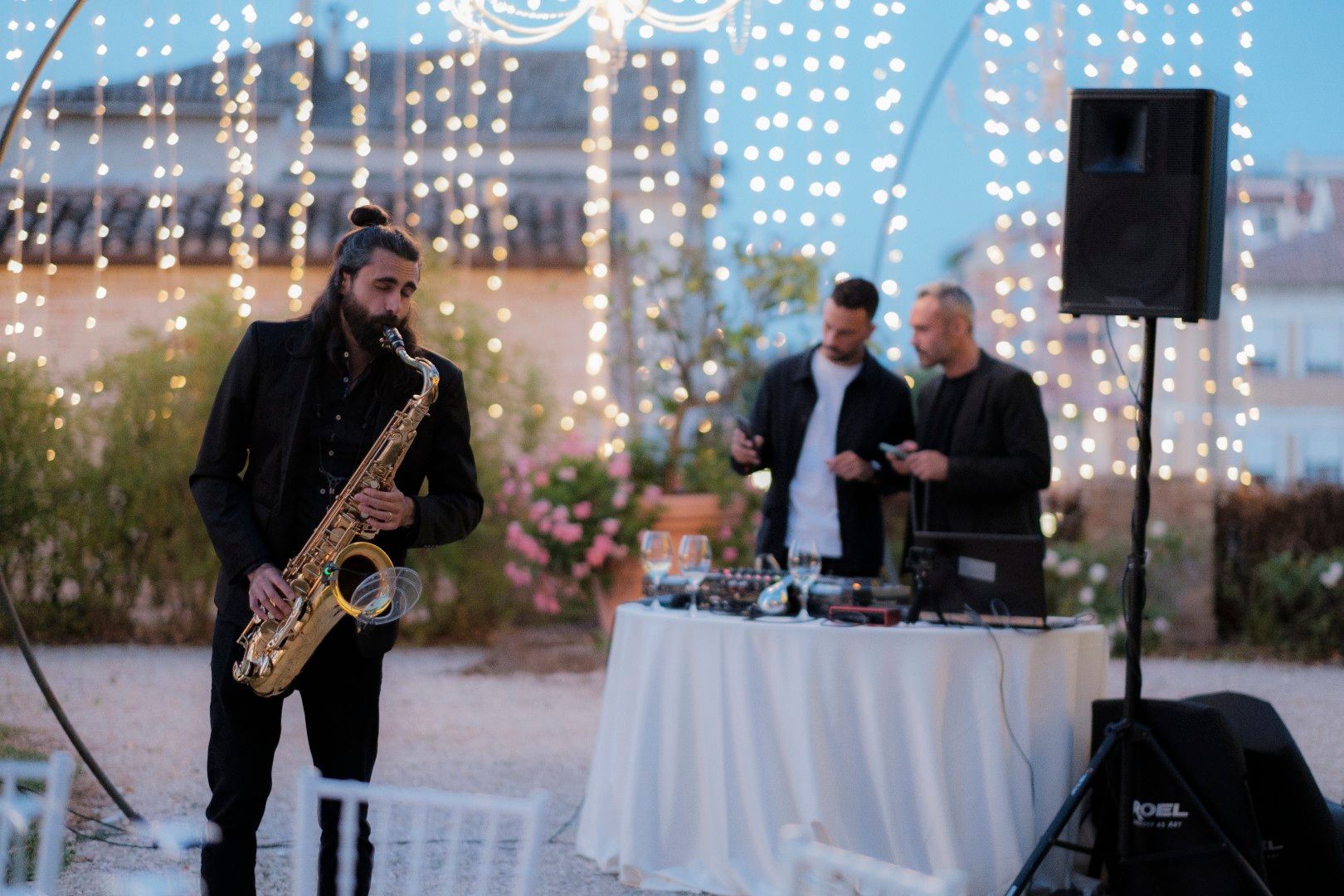
The aperitivo is one of the most natural moments for live jazz. Guests are standing, moving around, talking and having a drink. The music should have personality and rhythm while keeping conversation easy. Bossa nova, swing, Italian songs arranged in a jazz style and elegant standards work very well.
Dinner requires particular attention to musical intensity. The right band knows how to fill the room without forcing guests to raise their voices. It is not only a question of volume: experience, repertoire, instrumentation, amplification and the position of the musicians all matter.
The reception or after-dinner part depends on the couple's taste. Some want to dance with a live band or a DJ; others prefer a relaxed and refined atmosphere. A jazz quartet is especially versatile here: it can remain calm and contained or bring out a more energetic rhythm with swing, samba, soul-jazz or Latin influences, without slipping into anything "commercial" and while keeping an elegant character.
Defining these moments in advance allows the musicians to suggest the right lineup and repertoire. It also avoids a frequent mistake: looking for a band "for the wedding" without yet having a clear plan for the different parts of the day. If you are unsure, rely on an experienced band and let them guide you toward the most suitable solution.
For example, here is a schedule for a 100-guest wedding at a villa, with the ceremony on site:
5:30-6:15 pm, ceremony in the garden
An acoustic duo accompanies the entrance, the vows and the exit. Contained volume, a selected repertoire.
6:15-7:00 pm, while the couple is with the photographer
Guests move toward the aperitivo area. Music accompanies the change of space and keeps guests company while they wait.
7:00-8:00 pm, aperitivo
Bossa nova, swing and Italian songs, with enough energy to give the moment character and create a convivial atmosphere.
8:00-9:45 pm, dinner
Sets of 30-40 minutes, alternated with short breaks and recorded background music. Volume stays below conversation level.
9:45-10:00 pm, cake cutting and first dance
A song chosen by the couple, live if possible. This is the moment when music can move to the foreground.
10:00 pm-12:00 am, party
The repertoire becomes more rhythmic: swing, soul, samba. Energy grows without the volume becoming excessive. Alternatively, a DJ takes over the atmosphere and keeps everyone on the dance floor late into the night.
Step 3: Choose the Right Ensemble Format
The size of the ensemble should follow the room, the number of guests and the role of the music.
There is no universal best format. A quartet is not automatically better than a duo, and a soloist is not automatically less refined than a full band. The right choice is the one that fits the moment with proportion.
| Format | Best for | Character |
|---|---|---|
| Soloist (sax, violin or piano) | Short ceremony moments, intimate aperitivo | Elegant, direct, minimal |
| Duo (sax/voice and guitar or piano) | Ceremony, aperitivo, dinner | Romantic, flexible, discreet |
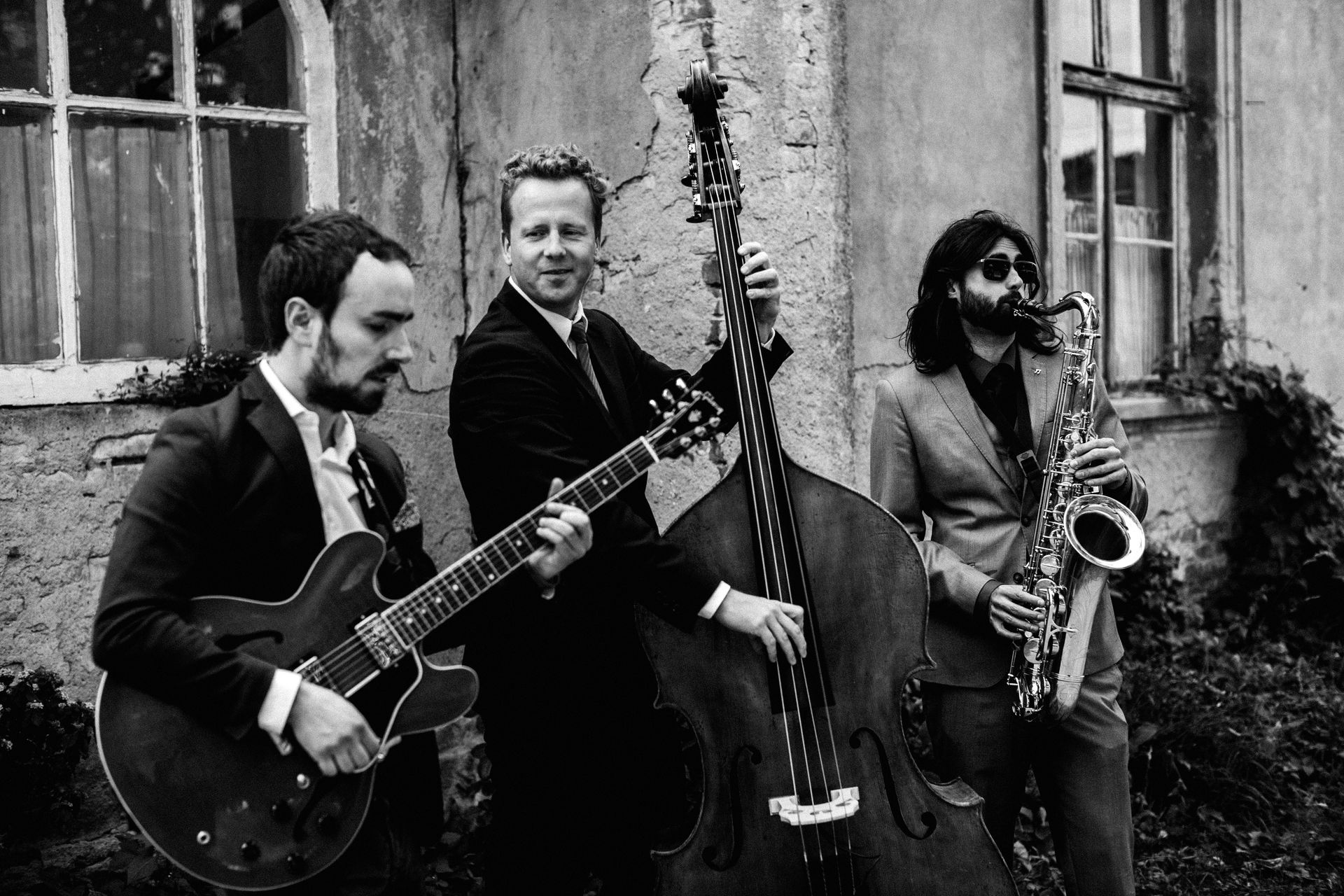
| Trio (sax, guitar, bass) | Ceremonies and refined receptions | Balanced, warm, natural |
| Quartet with drums | Larger receptions, more energy | Fuller, rhythmic, more dynamic |
| Quintet, big band or custom ensemble | Luxury weddings, large guest counts | Prestigious, expansive, tailored |
Listen to some examples of each format in our line-up videos.
For a ceremony, a duo may be more moving than a larger group. For an aperitivo with 100 guests, a trio or quartet can offer a good balance between energy and discretion. For dinner in a highly reverberant historic room, drums should be assessed carefully. For an outdoor reception, amplification, wind and cover may matter more than the number of musicians.
If the wedding includes very different phases, the solution can be modular: duo for the ceremony, trio for the aperitivo, quartet for the reception. A good musical director knows how to build this progression in a fluid and natural way.
Step 4: Evaluate Venue, Acoustics and Logistics
Italian wedding venues are beautiful, but they are not always simple from an acoustic point of view.
Historic villas, castles, cloisters, stone courtyards and marble halls create atmosphere, but they can also produce a lot of reverberation.
Before confirming the music, collect practical information:
- where the musicians will perform during each part of the day
- whether ceremony, aperitivo and dinner happen in different spaces
- power access and distance from sockets
- restrictions on volume or curfew
- load-in time, parking and access to the venue
- rain plan for outdoor music
- whether the venue has a sound system and whether it is actually suitable for live music
Do not assume that the venue sound system is enough. Many systems installed in hotels or villas are designed for speech and background playlists, not for live instruments.
A professional band will almost always have its own amplification and will be able to advise you on the best setup. Leaving the technical side to professionals allows you to stay relaxed during the day and avoid surprises.
Good logistics remain invisible to guests, but they are one of the reasons a live performance feels natural.
Step 5: Bring Together Personal Taste and Guest Experience
The key word is care. Do not turn the band into a jukebox. Share your tastes, meaningful songs, artists you love and styles you do not want. Then let the musicians build a coherent repertoire around the flow of the day.
Jazz works well because it can feel international without becoming anonymous. It allows Italian atmosphere, American standards, Brazilian rhythms, French chanson and contemporary material to live inside one elegant musical language.
The most successful weddings usually combine three elements:
- a few personal musical moments chosen by the couple
- a refined core repertoire selected by the musicians
- flexibility on the day, because the room always reveals what guests respond to
One aspect that is often overlooked is the guest profile. Average age, nationality and cultural background influence the repertoire more than one might think. Songs that an international audience may find charming, some Italian classics for example, can feel predictable to Italian guests. If the wedding brings together guests from several countries, tell the band: an experienced group knows how to prepare a suitable repertoire without losing character.
Step 6: Evaluate the Musicians Before Booking
Choosing musicians for a luxury wedding means evaluating reliability, taste, communication, style and experience.
Listen to the recordings, but look at the context as well. An excellent musician in concert does not necessarily know how to manage a wedding dinner. Event experience matters because a wedding requires sensitivity to timing, volume, coordination with suppliers and the flow of the guests.
Before booking, ask practical questions:
- What ensemble format would you recommend for our venue and guest count?
- Can you play ceremony, aperitivo, dinner and reception with different energy levels?
- Do you provide sound equipment?
- Who coordinates with the planner or venue?
- How do you handle outdoor conditions or bad weather plans?
- Can you arrange one or two meaningful songs?
- What information do you need from us before the wedding?
The answers will tell you a great deal. A serious professional will not simply say yes. They will ask about the venue, timings, spaces, guests and atmosphere. They will help you avoid problems before they appear.
Remember that you are entrusting the musicians with an important part of the character of the day.
Step 7: Coordinate Musicians, Venue and Suppliers
A wedding involves many suppliers: planner, catering, photographer, celebrant, venue manager and musicians. Most problems can be prevented with one meeting or one shared document.
What the band needs:
- From the planner or venue: the full schedule of the day, with times for the ceremony, aperitivo, dinner, cake cutting and first dance.
- From catering: the service timing, so musical sets can follow the courses.
- From the venue: load-in access time, parking, power sockets and the spaces assigned to each phase.
- From the celebrant: the structure of the ceremony, with the exact points where music enters and stops.
What other suppliers need from the band:
- The technical rider: required space, power and equipment.
- Arrival and soundcheck times.
- The name and phone number of the musical contact person for the wedding day.
A few days before, it's useful to have a short conversation between the band and the organisation (planner, couple, venue, catering, and so on), to confirm the schedule and operational cues (when the music starts and stops, special moments, and so on). This helps avoid last-minute misunderstandings.
Step 8: Manage the Budget Carefully
With live music you are not only paying for the number of musicians, but also for event experience, repertoire preparation, equipment, coordination with other suppliers and the ability to handle the unexpected without guests noticing.
Indicative price ranges for Italy (2026):
| Configuration | Typical range | Best for |
|---|---|---|
| Soloist or duo (ceremony or aperitivo) | €1,200 - €2,200 | Intimate ceremonies, guest arrival, small aperitivos |
| Jazz trio | €2,100 - €3,600 | Aperitivo and dinner, villa weddings up to 150 guests |
| Quartet with drums | €2,600 - €4,800 | Full-day coverage, receptions with a dancing finale |
| Modular ensemble | €3,200 - €5,500 | Ceremony, aperitivo and reception, with different musicians in each phase |
| Custom ensemble | From €5,500 | Luxury weddings, destination weddings, multi-day events |
These figures are indicative and normally include musicians, a professional sound system, taxes and travel. When comparing quotes, always check what is included: a price that excludes VAT, equipment or travel can grow well beyond the initial figure.
If the wedding lasts the whole day across several spaces, ask whether the band also handles full musical coordination, with moves between areas and a single operational contact.
Wedding Music Checklist
The earlier music enters the planning process, the simpler everything becomes.
9-12 months before
- General musical direction defined
- Band availability checked, especially for summer dates and weekends
- Quote received and contract signed
3-6 months before
- Ensemble chosen for each phase: ceremony, aperitivo, dinner, party, other moments
- Draft schedule shared with the band
- Venue information shared: spaces, timings, volume limits
- Planner or venue manager contacts sent to the band
1-2 months before
- Special musical requests confirmed (first dance, entrances, dedications)
- Technical requirements confirmed: spaces, power sockets, rain plan
- Final schedule shared with the band
On the wedding day
- The band arrives for setup and soundcheck at the agreed time
- Operational contact person assigned to the band (planner or trusted person)
- Final schedule handed to the band's contact person
- End time and breakdown logistics confirmed
The schedule does not need to be organised like a military plan, but the clearer it is, the fewer unexpected issues there will be.
Common Mistakes to Avoid
Choosing on price alone.
Be wary of prices that are far below the rest of the market. If a band costs half as much as most others, it is likely that they have limited experience or are hobby musicians. An excellent duo is often better than a larger group with less experience.
Requesting too many disconnected songs.
A few personal choices can be beautiful, but a long list of disconnected requests can make the performance feel less elegant.
Underestimating the technical side.
Outdoor ceremonies, large gardens and changes of space all require planning. None of this is difficult if it is handled in advance, but it can become stressful if discovered on the day itself.
Relying on "wedding professionals".
Look for musicians with real wedding experience who still maintain artistic sensitivity and passion. If you want a truly special atmosphere, do not limit yourself to the most popular wedding bands.
Confusing energy with volume.
A refined wedding can become lively without becoming noisy. Experienced musicians can raise the energy without the music becoming loud.
Conclusion
Choosing wedding music means designing the right atmosphere for each moment of the day.
Start from the memory you want to create for yourselves and for your guests. Distinguish between the ceremony, aperitivo, dinner and reception. Choose the ensemble with proportion and respect the venue. Coordinate suppliers and plan the budget with care. Share your personal taste, then leave the musicians the space to shape the repertoire with experience.
If you are planning an elegant wedding in Italy, Jazz Band Italy can help shape the music from the first idea to the final performance, with live jazz that feels refined, personal and beautifully suited to the setting.
About the Author
Milo Lombardi is the saxophonist, composer and artistic director of Jazz Band Italy. Over the past ten years he has curated live music for more than one hundred weddings and events across Italy and Europe, for clients including the German government, Maserati, Mercedes-Benz, TOD's, Ernst & Young and Deutsche Bank.